Hungary: a truce, not a revolution
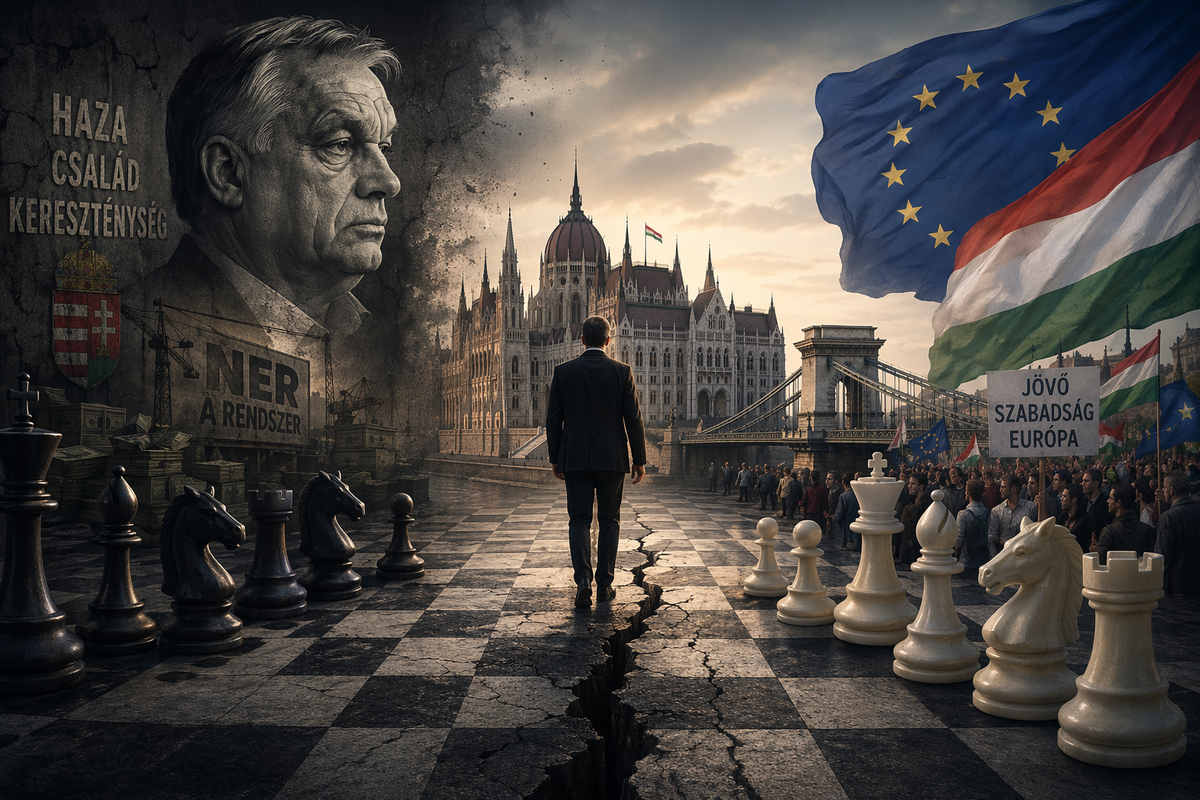
The change at the top in Budapest is not a simple democratic fluctuation, but a fracture in the European political landscape. After sixteen years of hegemony, the order built by Viktor Orbán has registered a structural failure under the weight of record turnout, culminating in a defeat that takes on the contours of a collective trauma. The event presents itself as a historical fact: the decline of the Magyar model is not merely the fall of a leader, but the dismantling of a governing architecture grown in the shadow of the Crown of Saint Stephen. Yet this turning point should not invite easy enthusiasm. The handover raises a question about the nature of change: are we witnessing a palingenesis, or a systemic act of camouflage?
Skepticism as an analytical posture: form versus structure
The analysis of transitions requires a distinction between a change in governmental physiognomy and the uprooting of deeper dynamics. In this context, methodological doubt must not be confused with cynicism. Power is not an object one possesses, but a web of relations that does not vanish when its principal interpreter exits the stage. According to this view, formal sovereignty resides in the palace, but real influence is displaced into the folds of bureaucracy, the nodes of the economy, and the so-called neutral institutions.
Authority does not dwell only in parliament or in the courts: it sediments through practices and languages that produce compliant subjects. Orbán governed through normalization, transforming nationalism, homophobia, and distrust of the outside into common sense, into a cultural common sense that no longer requires decrees to reproduce itself. This is the enduring legacy of the system: not the norms that Péter Magyar may repeal, but the bodies and perceptions that those acts have shaped. A new executive can change the written text, but it cannot, by law, undo the subjectivity that has been generated. Orbán’s control resides in the mentality of a population that has breathed, for sixteen years, an air that does not renew itself with a vote.
The category of the façade transition: the Magyar–Medvedev parallel
To understand the possible continuity of the regime, one must analyze the figure of Magyar not through personal resentment, but as a category. The parallel with Dmitry Medvedev’s interregnum in Russia is illuminating: a phase that serves to normalize the country’s external image without eroding its oligarchic foundations. In a consolidated system, the scaffolding does not need its creator in order to persist; it requires, paradoxically, a successor who does not demolish it.
This “façade transition” manifests when the new leader, while employing a reformist lexicon, remains entangled in pre-existing networks of interest. If Magyar’s action were to stop at the communicative surface, the electoral victory would resolve itself into an operation of cosmetic adjustment. The risk is that Hungarian democracy becomes a technocratic oligarchy, less noisy but equally impermeable to popular sovereignty. Power regenerates itself through the sacrifice of its most worn-out face in order to preserve privilege.
Criteria of verification: the nodes of transformation
The real will to break with the past will be measured along four axes, tests of sincerity for the new course.
Civil rights and self-determination: The first proving ground concerns the LGBTQ+ community. Under the previous leadership, state-sponsored homophobia functioned as an identity glue. A genuine reversal would require the repeal of restrictive laws and the opening of a season of inclusion. The forecast is that the government will attempt a downward mediation, granting formal freedoms without touching the conservative substratum on which its consensus rests. Those who are not gay are equally subjected to that norm, because they internalize its limit.
Restoration of legality and European funds: The management of EU funds is the Gordian knot. To unlock resources from Brussels, Budapest must guarantee judicial independence and transparency in public procurement. Fighting corruption means striking at Magyar’s former allies. If financial flows resume without radical reforms, the mechanism will have simply changed its beneficiary.
Geopolitical relocation and the relationship with Moscow: The bond with the Kremlin has been a pillar of foreign policy. The transition must show whether proximity to Russia was an idiosyncrasy of Orbán or a choice embedded in the apparatus. A real distancing would manifest through diversified energy cooperation, beyond declarations of intent.
Balkan enlargement: The position on EU accession for Albania, North Macedonia, Kosovo, Bosnia, and Montenegro will reveal whether Hungary will stop using the Balkans as a bargaining chip. The removal of vetoes would mark a return to the ranks of European cooperation.
The decisive criterion: the assault on assets
Every analysis, when it approaches its real core, loses the comfort of categories and touches the bare matter of power. Everything else — rights, alliances, rhetoric — remains an interpretable surface. The center, instead, is less elegant: it is what remains when words are no longer sufficient to mask relations.
In Hungary, that center coincides with the transformation of the State into a patrimonial ecosystem. Not an intertwining of politics and economics, but a slow, sedimented fusion: the State as a generator of rents, protections, and invisible hierarchies. For this reason, the true test of the new course is not played out in press releases, nor in international summits. It is played out in the capacity to generate friction with what made the previous system possible.
Civil rights, the judiciary, European funds, geopolitical posture: these are all readable surfaces of change. But surfaces do not explain structure. The latter reveals itself only when something is struck and ceases to function as before. If the change is real, it will produce resistance. Not declared, not ideological: material. In the networks that sustained the equilibrium, in the mediations that transformed the public into private infrastructure, in the links between leadership and the distribution of resources. Without this friction, every reform remains a variation in language. A substitution of form.
The decisive point is not the direction of the turn, but its depth. How far down it reaches. How deeply it cuts. If patrimonial structures remain intact, the political change will be limited to redrawing the skin of power. If they are struck, then the transition will cease to be administrative and will become systemic. Between these two levels there exists only an unstable threshold. Not a choice, but a tension that resolves itself over time. And it is within that threshold that the event loses its democratic lightness and becomes a test of historical continuity.