Trump and the Delusion of Omnipotence
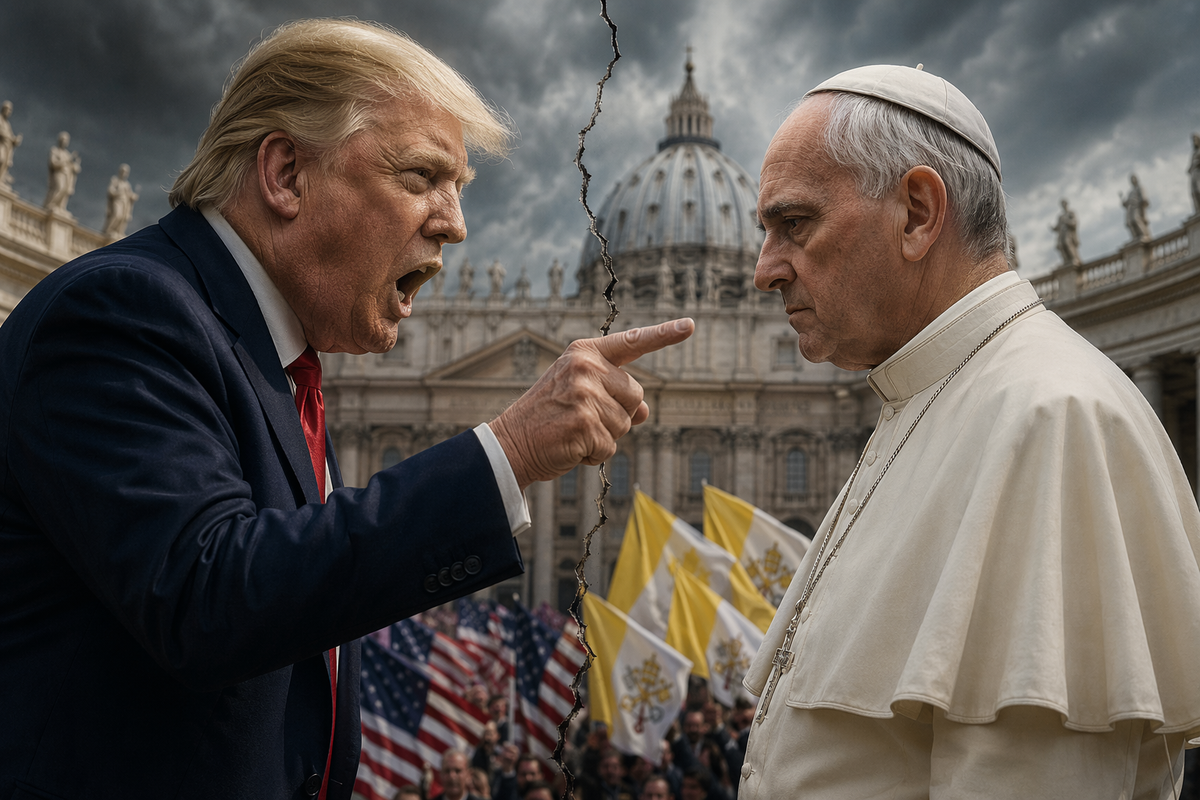
I am the last person who could wear the robes of the Pope’s defender. Those who regularly follow these columns, perhaps with the patience one reserves for lost causes, know well that I have never spared harsh criticism of ecclesiastical institutions. I have often described the Vatican as the motionless gear of a dusty power, a medieval inheritance struggling to find a modern breath. And yet, in the face of the drift of the past twenty-four hours, every ideological divergence must necessarily step back. There comes a moment when criticism of dogma must yield to the defense of civilization. What we have witnessed is not a simple mishap or a campaign gaffe; it is a systemic breaking point that intertwines political cynicism and private ties into a perverse knot, capable of suffocating the most elementary norms of institutional and human respect. When politics invades the sacred, it almost never does so out of faith, but through subtraction. Subtraction of authority, of dignity, of meaning. Donald Trump’s attack on the papal throne is neither a theological critique nor a diplomatic disagreement over borders or migration flows. It is an act of dismantling symbols. The attack: the family as a battlefield Donald Trump has shattered that unwritten protocol, an armor of formal decorum that had held for centuries between the banks of the Tiber and those of the Potomac. Even at moments of maximum tension between the White House and the Holy See — one thinks of clashes over social justice or the environment — a neutral zone had always been maintained, a respect for the institution that transcended its temporary occupant. Today that safeguard has been razed to the ground. Trump lashed out at the Pontiff with an unprecedented verbal violence, marking the passage from political dissent to tribal aggression. We are no longer within the perimeter of a clash between sovereigntism and universalism; this is an ad personam assault that seeks to strike the man behind the vestment, deliberately targeting his most intimate affections in order to undermine his emotional stability before his political standing. His statements are blows aimed at splitting the very unity of the Church, searching for an internal foothold that might turn the Vatican into a reality-show arena: “The Pope is weak and a failure in foreign policy. I strongly prefer his brother Louis, who is totally MAGA. He understands everything.” Such remarks are intolerable to anyone who still recognizes value in the dignity of public office. It is the first time in the modern era that a head of state not only openly attacks the Vicar of Christ, but attempts to delegitimize him by leveraging a member of his own family. The reference to Louis Prevost, the Pope’s brother and a known supporter of the American populist movement, represents a strategy of rare ruthlessness: dragging a fraternal bond through the mud of propaganda, turning blood into a pressure weapon aimed at the Holy See. This is politics becoming personal retaliation, debate sliding into the mechanics of emotional blackmail. Trump understands that consensus today is built on extreme polarization, but here he has taken a further step: he has turned theology into a matter of family feud. If the Pope’s brother stands with me, the tycoon implies, then the Pope is a usurper of truth. It is a logic that flattens the complexity of religious thought into a crude choice between opposing fan bases. The response of Pope Leo XIV: the asceticism of silence Despite the ferocity of the blow, which would have unsettled even seasoned diplomats or politicians accustomed to confrontation, the Holy See chose the path of solemn composure, almost hieratic. Before the journalists crowding the Press Office — amid the astonishment of reporters expecting a sharp reply, an indignant denial, or a formal condemnation — Pope Leo XIV responded with a firmness that suggests a deeper moral altitude. He used no adjectives, sought no counterattack. He simply marked the boundaries of his spiritual space: “I am not afraid.” “I do not intend to open a debate with him.” In these few syllables, one measures the abyss separating two irreconcilable visions of the world. On one side, the hypertrophy of the ego, the constant need to occupy communicative space with noise and insult; on the other, the strength of detachment. Leo XIV has not merely defended himself; he has protected the function he embodies, rendering the offense irrelevant through the force of refusal. The Pontiff’s silence thus becomes louder than the shouts coming from across the ocean. It is a demonstration that real power does not need to shout in order to exist, while authority that feels threatened must constantly seek confrontation to affirm its vitality. Yet this composure should not mislead. Behind the “I am not afraid” lies the awareness of a Church that feels under siege not from atheism, but from a new form of political religiosity that uses Christian symbols to empty them of their universal content. Beyond the limit: the “Messiah” of social media and the aesthetics of blasphemy But the most troubling signal in this episode does not lie in words, but in the aesthetics of power displayed in the hours that followed. We have now officially entered a phase of autarchic delirium bordering on collective hallucination. Shortly after the verbal attack, Trump posted on his digital channels an image generated by artificial intelligence that froze observers around the world. In the image, the former President appears draped in biblical garments, portrayed as a new Messiah, placing his hand upon the head of a dead man to raise him amid a flare of artificial lights and star-spangled flags. This iconography is not only profoundly blasphemous to believers; it is politically alarming for the stability of any democracy. We are no longer in the realm of classical populism or heightened electoral provocation; we are facing a radical self-deification that shifts the plane of consensus from reason to blind faith. It is a deliberate attempt to replace a millenary authority with an instantaneous, visual, digital cult of personality, where the leader does not ask for votes, but for absolute devotion. The use of artificial intelligence to create false visual miracles is the perfect culmination of the age of post-truth. If I can show myself resurrecting the dead, what weight can the words of an old man dressed in white, speaking of welcome and humility, still carry? Trump’s challenge is total: it is a challenge to the monopoly of the sacred. The crisis of Western institutions Faced with this scenario — between personal attacks, induced family fractures, and digital messianism — a question arises, immediate and urgent: how long can a leader who has lost all sense of measure and limit remain at the helm of a superpower? The stability of Western democracies does not rest solely on written laws or international treaties, but on respect for institutions and the emotional balance of those who govern them. Yesterday, both of these pillars appeared dangerously fragile. The real danger is not only Trump, but what he represents: the end of mediation. If even the Pope becomes a target to be struck through his relatives, if even religion becomes an AI image to be manipulated for electoral ends, then no shared public space remains. What is left is a jungle of electrical signals where the loudest voice wins, and where truth is nothing more than an accessory of ambition. The boundary has been crossed. Now we must ask what remains on the other side. The fragility of democratic pillars, shaken by this unrestrained narcissism, forces us into a choice: either we recover the value of limit and institutional respect, or we accept that the governance of the world becomes the stage for a delirium that admits no reply.