The Fall of the Emperor: Power, Illusion, and the Strait of Hormuz By Benedetto Salvi
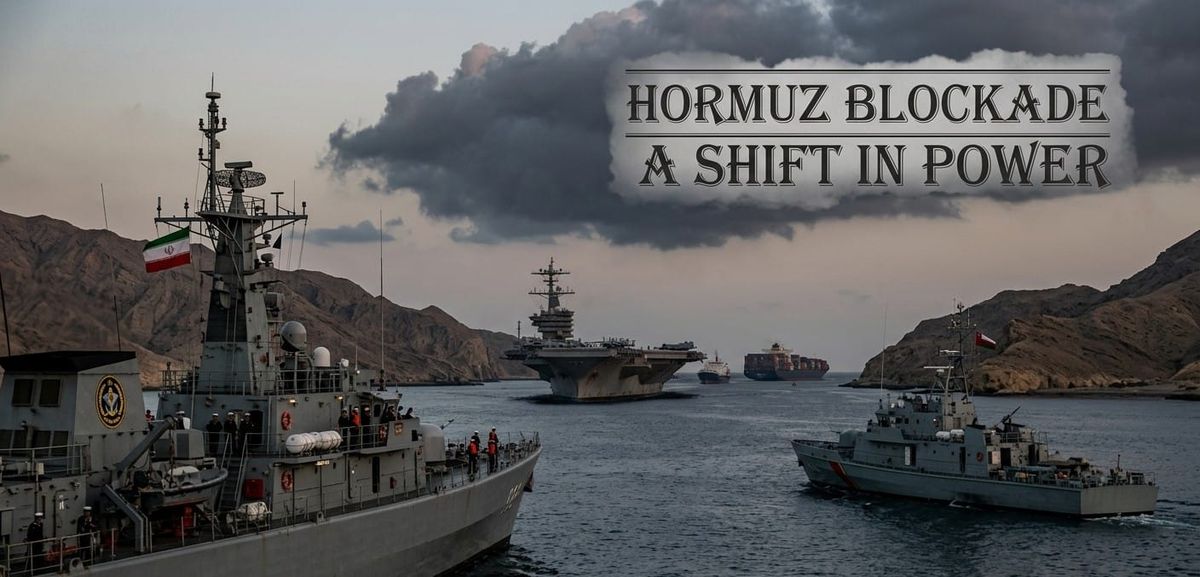
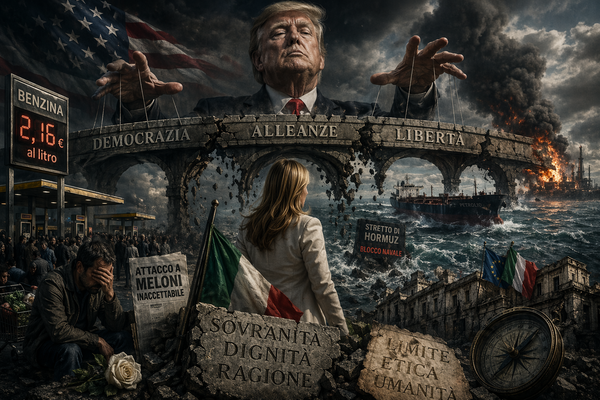
There is a particular moment in the life of every empire when reality stops negotiating with narrative. The recently announced ceasefire between Washington and Tehran may well be that moment for the United States. Presented by Donald Trump as a triumph of strength and deal-making prowess, the agreement is, on closer inspection, something far less flattering: a quiet admission that the rules have changed—and that Washington is no longer the one writing them. The war was launched with the clarity of absolute objectives. Regime change in Tehran. The dismantling of Iran’s nuclear ambitions. The neutralization of its missile arsenal. Full control over the Strait of Hormuz, the world’s most critical energy chokepoint. No ambiguity, no half measures. None of it materialized. Iran’s leadership remains in place, not weakened but paradoxically reinforced. Its strategic posture is intact. Its missiles are still where they were—silent, visible, and untouched. And its nuclear trajectory, rather than being erased, risks being absorbed into a new geopolitical architecture shaped not by Washington, but by Beijing. This is not a tactical setback. It is a structural failure. The most telling detail is not what was lost, but who stepped in. The agreement was not brokered in Washington, nor in Brussels, but along a Beijing–Islamabad axis that would have been unthinkable as a primary diplomatic channel just a decade ago. Power does not vanish; it migrates. And in this case, it has moved with remarkable clarity. Even more revealing is what has happened in the Strait of Hormuz. Long imagined in Washington as a corridor ultimately secured by the presence of the U.S. Fifth Fleet, it is now drifting toward a bilateral equilibrium between Iran and Oman. The implication is stark: the West no longer guarantees the flow of energy—it negotiates it. Empires rarely collapse in dramatic explosions. More often, they thin out, like a shadow at noon, until what remains is shape without substance. What we are witnessing is not the absence of American power, but its diminishing ability to impose outcomes. Nowhere is this more evident than in Washington’s relationship with Israel. As diplomatic efforts attempted to stabilize the ceasefire, Israeli operations in Lebanon escalated with devastating intensity, producing civilian casualties on a scale that instantly destabilized the fragile balance. The message, unintended but unmistakable, is that the United States can no longer reliably discipline or direct its closest allies. An empire that cannot coordinate its own axis is no longer an empire. It is a participant. Iran understood this immediately. Its response—the renewed closure of the Strait of Hormuz—was not just retaliation. It was demonstration. A signal that leverage now flows in multiple directions, and that agreements without enforcement are little more than temporary theater. And theater is precisely the point. Because what remains of American dominance, in this moment, is increasingly performative. The language of victory persists. The rituals of power continue. But behind them, the machinery struggles to convert force into order, pressure into compliance, alliances into coherence. Meanwhile, China does not declare victory. It brokers. It absorbs. It waits. And in doing so, it offers something the current American posture no longer guarantees: predictability. This is the true fracture line. Not military, not economic—but psychological. The world is beginning to recalibrate its expectations, shifting from a system where Washington dictates terms to one where it negotiates from within the system like any other actor. Iran emerges from this crisis not as a defeated state, but as a node in a new network—protected, connected, and increasingly central to an Asian-led geopolitical framework. It has not won in the traditional sense. It has simply outlasted the premise of its own defeat. History will not remember this ceasefire as a victory. It will remember it as a reveal. The mask did not fall in a single moment. It slipped, gradually, until it could no longer hold. What remains is not the end of American power, but the end of its illusion of inevitability. And in geopolitics, that is where every real transformation begins.